Tropical Vibes Font: A Designer’s Review
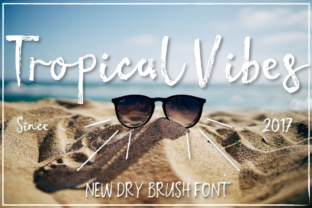
I was staring at a blank brand board for a boutique skincare line last Tuesday, trying to capture that specific feeling of sun-drenched relaxation without falling into the trap of cliché palm tree clipart. The client wanted something organic, feminine, and effortlessly cool. I scrolled through my library of Fonts, bypassing the usual suspects, until I landed on Tropical Vibes. It wasn’t just another script; it was a hand-painted dry brush typeface that felt like it had been created with actual ink and paper, not just vector points. After testing it across a logo draft, packaging mockup, and social media layout, I can confidently say this is a standout addition to any designer’s toolkit.
The Hand-Painted Personality
What makes Tropical Vibes distinct is its texture. As a dry brush font, it retains the natural imperfections of hand-lettering. You can see the stroke variation where the "brush" lifted or pressed harder against the "paper." This isn’t a clean, digital sans serif; it’s got grit and soul. For a project rooted in natural ingredients and handmade care, this visual characteristic does half the heavy lifting. It communicates authenticity before the customer even reads the product description.
The mood is undeniably feminine but not fragile. It has a confident sway to it. When I dropped it into a logo concept for the skincare brand, it didn’t need excessive embellishment. The letters themselves carried enough visual weight and personality to stand alone as a primary logotype. This is crucial for modern branding, where simplicity and recognition are key. If you are looking for a premium font that feels bespoke rather than stock, this typeface delivers that custom-hand-lettered look without the custom price tag.
Performance in Real Branding Scenarios
I put Tropical Vibes through its paces across several touchpoints to see how it holds up in a real-world identity system. Here is how it performed:
- Logo Design: It works beautifully as a standalone wordmark. The connected strokes create a cohesive unit that feels established and professional. However, because it is a display font, it needs room to breathe. I avoided cramming it into tight spaces.
- Packaging Design: On a matte label mockup, the dry brush texture popped against the smooth background. It added a tactile quality that made the digital proof feel more physical. It’s ideal for product labels where you want to emphasize artisanal quality.
- Social Media Graphics: For Instagram stories and posts, it served as an excellent accent. I used it for short headlines like "New Arrival" or "Summer Glow," pairing it with a clean sans serif font for the body copy. The contrast created a clear visual hierarchy that guided the eye naturally.
- Web Design: In the hero section of a landing page, it acted as a strong focal point. However, I would caution against using it for navigation menus or small UI elements. Its strength lies in large sizes where the brush details are visible.
This versatility makes it a valuable asset for creative studios and freelancers who need a reliable commercial font for lifestyle, beauty, food, or hospitality clients. It bridges the gap between playful and professional, which is often a hard balance to strike.
Pairing and Visual Hierarchy
One of the most common questions I get from junior designers is about font pairing. With a characterful handwritten font like Tropical Vibes, the rule is simple: keep the supporting cast quiet. Because the typeface has so much movement and texture, it pairs best with neutral, geometric sans serifs or classic, understated serif fonts.
In my recent project, I paired it with a lightweight, modern sans serif. The clean lines of the sans serif grounded the airy, flowing nature of the script. This combination ensured that the brand identity felt cohesive rather than chaotic. If you try to pair it with another decorative or script font, you risk visual clutter. Let Tropical Vibes be the star. Use your secondary typography for readability and structure, allowing the primary typeface to handle the emotional connection and brand perception.
Limitations and Practical Considerations
While I love this font, it is not a one-size-fits-all solution. It is explicitly a decorative font meant for headlines, logos, and short phrases. Do not attempt to use it for body text, long-form editorial design, or small print on business cards. The dry brush edges will blur at small sizes, reducing legibility and making the text look messy rather than artistic. It is not suitable for corporate, legal, or highly formal contexts where clarity and neutrality are prioritized over style.
Before finalizing any client work, always test the font at various sizes. Print out a proof if possible. What looks crisp on a retina display might lose definition on a textured paper stock. Also, check the included styles. While Tropical Vibes is powerful on its own, see if the package includes alternates or ligatures that can help you customize specific letter combinations to avoid awkward collisions or repetitive shapes. These small tweaks can elevate a good design to a great one.
Licensing and Final Thoughts
As with any creative font used in commercial projects, licensing is non-negotiable. Before you drop Tropical Vibes into a logo for a paying client, a packaging run for a product, or a template you plan to sell, review the license agreement carefully. Ensure it covers commercial use, webfont embedding if needed, and any restrictions on merchandise or print-on-demand products. Protecting your work and respecting the creator’s rights is part of being a professional designer.
If you are working within the Script Amp category or exploring new design assets for your library, Tropical Vibes is a worthy contender. It offers that elusive mix of relaxed vibe and polished execution. Whether you are refreshing a café’s visual identity, designing invitations for a summer wedding, or building a brand board for a handmade shop, this typeface brings a breath of fresh air. It reminds us that in a digital world, there is still immense value in the human touch.